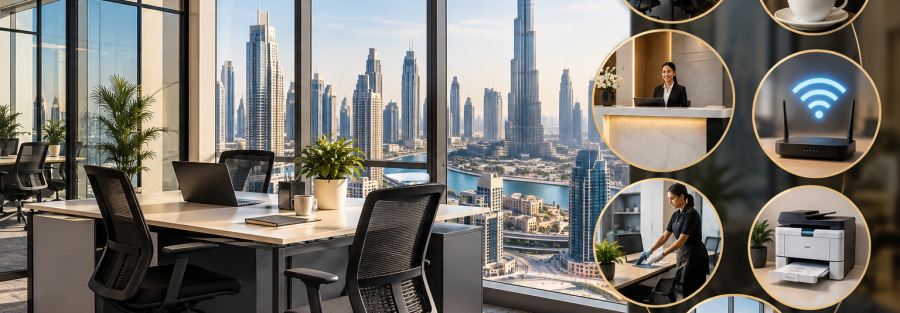
Search “serviced office for rent Dubai” and you’ll get a long list of business centres, most of them listing rent, a photo of a lobby, and not much else. What’s missing from most of those listings is the part that actually matters: what changes, practically, when you choose a serviced office over a traditional lease and what you should be checking before you commit to one.
The basic difference, without the sales pitch
A traditional office lease gets you four walls and a rental agreement. Everything else furniture, internet, utilities, reception, maintenance, Ejari registration is on you to arrange separately, and to pay for upfront. A serviced office bundles all of that into one monthly or annual rate, and the space is ready to walk into on day one.
That’s the whole concept. The value depends entirely on how well that bundle is put together, which varies a lot between providers.
What a serviced office rental in Dubai typically includes
At a properly run business centre, a serviced office rate should cover more than just desks and a lock on the door. At minimum, expect:
- Fully furnished office space, ready to use immediately
- High-speed internet and basic IT infrastructure
- DEWA (Dubai Electricity and Water Authority) services
- Reception and administrative support to handle calls and guests
- Cleaning and general maintenance
- Ejari registration, which is required for your tenancy contract to be legally valid in Dubai
Some providers go further with amenities like tea/coffee service, keyless secure entry, and on-site technical support. Others charge extra for things that sound like they should be included which is exactly why the fine print matters more than the headline rate.
What it actually costs
Pricing for serviced offices for rent in Dubai typically falls somewhere between AED 15,000 and AED 35,000 per year, depending on location, office size, and what’s bundled into the rate. That’s a wide range, and the reason it’s wide is that “serviced office” isn’t a standardised product a basic desk-and-internet setup in a secondary district and a fully staffed private suite in a prime district can both technically carry that label.
This is where comparing on rate alone falls apart. Two quotes that look close on paper can represent very different levels of service once you actually move in.
Why this model has become the default for so many businesses
Fit-out costs for a bare-shell office haven’t come down, even in periods when Dubai’s broader rental market has cooled. For a small office, furnishing and setup alone can approach a full year’s rent, paid upfront, before the business has generated anything from the space. That single fact is doing most of the work behind why serviced and flexible office space has been growing faster than traditional leasing across the UAE in recent years.
It also matches how most businesses are actually shaped right now. Dubai’s own leasing data shows the vast majority of new office transactions are for smaller footprints most under 3,000 square feet which tracks with how many startups, SMEs, and newly formed companies are entering the market and don’t want to commit years of capital to a space they haven’t tested yet.
Who should rent a serviced office, and who probably shouldn’t
Serviced offices tend to make the most sense for:
- New businesses still finalising trade licence or visa paperwork, who need an operational, Ejari-compliant address quickly
- Small and growing teams that don’t want to predict headcount three years out
- Companies that value flexible contract terms over full control of layout and branding
- Anyone who’s priced out a bare-shell fit-out and decided the upfront cost and delay aren’t worth it
A traditional lease can still make more sense for a larger, established business planning to occupy the same space for five-plus years with a specific layout and identity built into it at that scale, the economics of a custom fit-out amortised over a longer period can work out better.
What to actually check before signing
Before comparing rates between providers, confirm:
- Whether DEWA and internet are genuinely included or billed separately
- Whether reception and admin support are part of the base package
- What the minimum contract term is, and what flexibility exists to scale up or exit early
- Whether the space is properly Ejari-registered, since this affects your ability to use the address for licensing and visas
- What the actual location offers in terms of accessibility for your team and clients
Where location fits in
A serviced office’s value isn’t just about what’s inside the unit it’s also about where it sits. Rigga Business Center’s serviced offices, for example, are located in the Sheikha Maryam Building on Al Maktoum Road in Deira, close to Baniyas Metro Station, which matters in practice for teams and clients who rely on public transport rather than driving in every day. Deira also tends to offer more accessible pricing than flagship districts like DIFC or Downtown Dubai, without sacrificing the professional address a growing business needs.
Making the comparison properly
If you’re actively looking to rent a serviced office in Dubai, the useful exercise isn’t finding the lowest headline rate it’s comparing total value: what’s genuinely included, how flexible the contract is, and whether the location works for the people who’ll actually be using the space. Rigga Business Center’s serviced office space in Dubai includes furnished offices, free DEWA, Ejari registration, dedicated reception, and flexible payment terms as standard, which is worth using as a benchmark when comparing other quotes.
A serviced office is meant to remove friction, not just cost. If a provider’s package doesn’t genuinely do that, the lower number on the quote isn’t actually the better deal.